
Two Decisions, Two Timelines: Pricing and Rate Alignment After an Acquisition
The Integration Playbook | Article 7 of 9 | This series examines the seven decisions that determine whether an environmental firm acquisition delivers value. Start with Article 1 here.
When two firms merge, their billing rates almost never match, and closing that gap looks at first like a straightforward finance exercise: compare the numbers, calculate the difference, and phase in the change over a reasonable timeline. That work matters, but it is not where rate alignment actually gets tested. That comes in the first month when a project manager from the acquired firm and one from the acquirer are assigned to the same account in comparable roles and bill at different rates. Or when a longtime client opens an invoice and notices that a number that used to be smaller has changed.
Rate alignment is really two decisions, and they move on different timelines. The first is external: what the combined firm will charge the clients it just paid to acquire, and when existing contracts allow those prices to change. The second is internal: how the firm will align compensation, labor categories, billing-rate architecture, and target margins across the two legacy organizations. The decisions are connected, but they rarely move together. Article 1 of this series named both risks. This article looks at them more closely, and the harder part usually turns out to be the internal one because compensation and employee expectations can require attention immediately, while client pricing may remain contractually locked for months or even years.
The Client-Facing Risk Isn't Symmetric
To make the distinction simpler, consider a lemonade company, Best Lemonade, acquiring two stands. The first is a capacity stand; we will call it Acme Lemonade: it’s the same basic product, one more location, and more people available to serve customers. Its lemonade sells for $1.00 while the buyer, Best Lemonade, charges $1.50. The obvious response is to set the prices the same and raise Acme’s lemonade to $1.50 post-close.
But even in that simple example, the lower price may be part of what customers value. They may see the product as interchangeable and choose the stand because it is convenient, familiar, or less expensive. The fact that the buyer acquired it for capacity does not mean there is nothing to protect in its pricing or client relationships.
The second is a specialist stand; let’s call it Unicorn Lemonade. Customers walk past several competitors to buy what they believe is a distinctive recipe, paying a $2.00 per cup. The buyer does not yet know exactly what earns that preference: the recipe, the reputation, the person running the stand, the brand, or the experience surrounding the product. Leaving the price and brand alone can be a prudent temporary decision. But it is only strategic if the buyer uses that time to identify what sustains the premium, determine whether it will survive integration, and set a clear point at which the decision will be revisited.
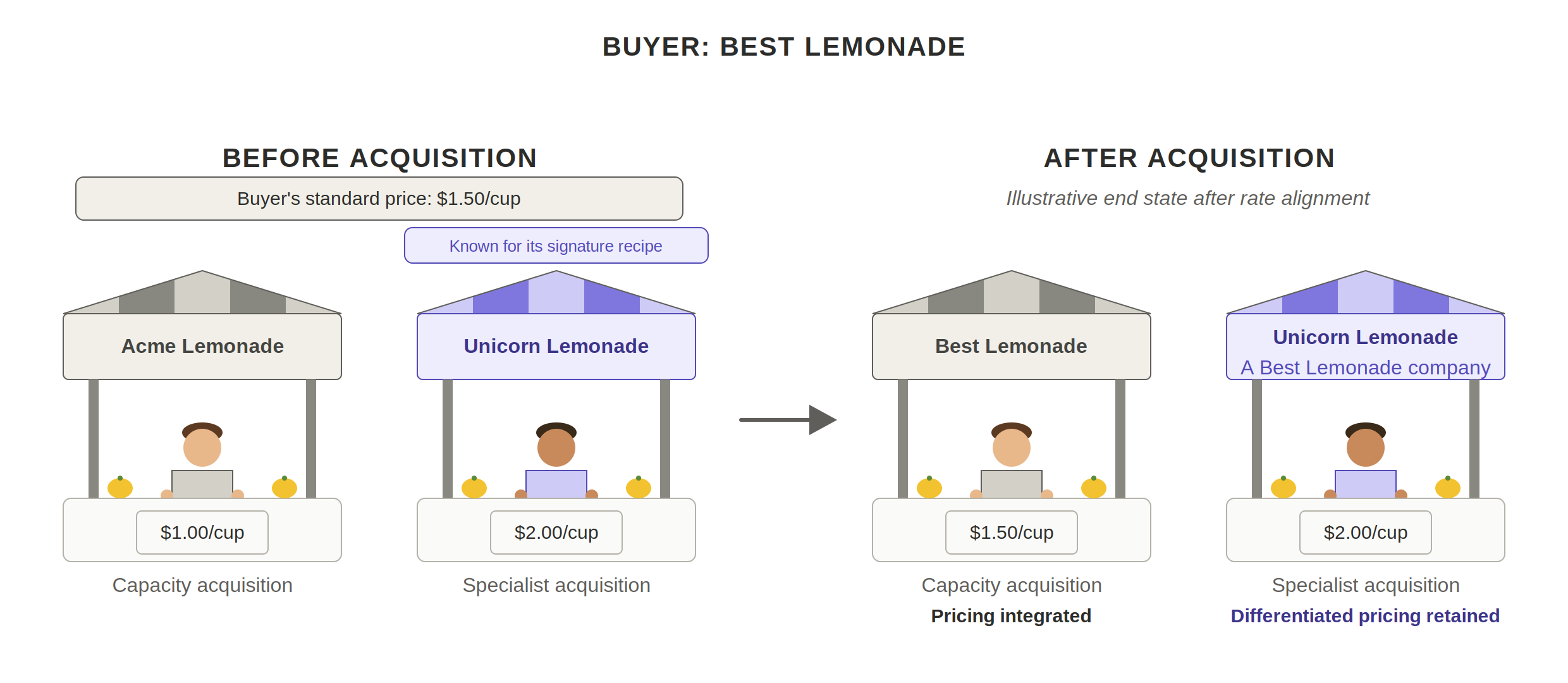
Figure 1. Pricing Alignment for Capacity and Specialist Acquisitions
Acme Lemonade’s customers may now be asked to pay more for what they perceive as the same cup. Unicorn Lemonade’s customers may continue paying the same price, but changes to the people, brand, or delivery model can gradually weaken the reason they were willing to pay it.
The same pattern appears in an environmental firm acquisition. A business bought mainly for capacity, additional staff, or geographic reach may not have an obvious premium position to preserve. That does not make client repricing simple. Clients may have selected the firm partly because of price, responsiveness, local relationships, or a lower-cost delivery model. A rate increase needs a reason beyond the acquisition itself and should be introduced at a moment the contract and relationship can support, such as an annual escalation, renewal, new task order, or meaningful change in scope. The conversation should be led by the person who owns the relationship, not delivered for the first time through a mass email or a system-generated invoice.
A specialist acquisition carries a different risk. The acquired firm may have a technical reputation or niche the acquirer did not already have in-house, but leadership may not yet know what actually supports its premium pricing. It could be a certification, a track record, a relationship, a particular individual, a faster response model, or some combination of them. Holding the rate and brand steady can protect the client relationship while leadership learns more. What cannot remain unresolved is why the premium exists, how it will be communicated, and who will defend it when pressure builds to standardize pricing across the combined organization.
That is why the client-facing risk is not symmetric. A capacity acquisition can create immediate attrition risk if prices rise faster than the client sees additional value. A specialist acquisition is more likely to lose value gradually if integration strips away the differentiation that supported the premium in the first place.
For accounts where rates will change, the mechanics matter as much as the direction. Firms that manage this well sequence changes by client tier, contract renewal date, service line, and competitive exposure rather than resetting every account on the same calendar day. High-risk relationships receive more deliberate handling, and the change does not arrive as one visible jolt across the entire client base. Clients buying commoditized services, where alternatives are readily available, will respond differently from clients buying specialized work where the firm's expertise is harder to replace. Treating every scope the same concentrates switching risk in the accounts that are already most exposed to competition.
The sequencing and messaging approach covered in Article 5, on client communication, applies directly here. A rate change that arrives without warning lands very differently from the same change discussed by the account lead in the months ahead, with a credible explanation of what the client is receiving in return.
The Contract Determines Which Timeline Can Move
Before leadership decides how quickly to align rates, it has to separate what the firm wants to change from what each contract permits it to change. Environmental firms commonly work under a mix of master service agreements, time-and-materials or labor-hour contracts, negotiated rate schedules, task orders, annual escalation provisions, and firm-fixed-price assignments. Each creates a different path and timeline for repricing.
On federal time-and-materials work, for example, the contract establishes fixed hourly rates by labor category that include wages, overhead, general and administrative expense, and profit. Firm-fixed-price contracts generally do not adjust simply because the contractor's labor costs or internal economics have changed. Private-sector agreements vary, but the practical issue is the same: compensation and internal parity may need attention long before the firm can increase the amount charged to the client.
That gap creates a margin bridge. The combined firm may need to raise an employee's compensation, change a title or labor category, or correct an internal inequity while continuing to bill the employee under an inherited rate schedule until renewal. If leadership has not identified and budgeted for that period before close, rate alignment becomes an unpleasant post-close surprise rather than a managed integration cost.
The diligence question, therefore, is not simply, 'How far apart are the two rate cards?' It is, 'Which rates can change, when can they change, what client or contractual approvals are required, and what happens to margin while the internal and external timelines remain out of sync?'
The Comparisons Employees Make Themselves
The lemonade example has only two prices to compare. A real acquisition has dozens or hundreds, and the people making the comparisons are not only owners or finance leaders. They are the employees staffing projects, building budgets, reviewing work plans, and entering time against the same accounts.
AEC firms do not all establish billing rates in the same way. Some use salary-based billing multipliers. Others use labor categories, market-based or sector-specific rate cards, geographic schedules, client-specific pricing, or negotiated contract rates. Zweig Group's 2026 Fee + Billing Report found that 30 percent of firms used salary-based billing multipliers, while 35 percent varied billing rates by market or sector. Whatever methodology a firm uses, its rates ultimately have to support direct labor, overhead, and profit.
That is related to, but not the same as, net multiplier. Net multiplier is an achieved performance measure calculated as net revenue divided by direct labor cost. Industry benchmarking summarized by Northstar Financial Advisory places a healthy firm-level target at roughly 2.75 to 3.25. The result is affected by actual billing rates, realization, write-downs, utilization, staffing mix, and project performance. It is not simply the markup applied to one employee's salary.
Employees generally cannot calculate a colleague's individual multiplier without knowing what that person earns. They do not need that information, however, to notice unexplained billing-rate differences. Once people from both legacy firms are assigned to the same projects, pricing that previously remained inside separate organizations becomes visible in budgets, resource plans, accounting systems, and client rate sheets. Zweig Group reports that broad internal visibility of billing rates has risen to 79% of firms, making these comparisons increasingly difficult to avoid.
Centralized onboarding or limited early cross-staffing may delay those comparisons, but it cannot prevent them. Eventually someone sees that a colleague with the same title and apparently comparable experience is billed at a meaningfully different rate. The difference may have a legitimate explanation: a client-specific contract, a different labor category, geographic pricing, a scarce certification, or a specialized market position. But when leadership has not defined or communicated the logic, employees fill in the blank themselves.
That is how billing-rate inconsistency becomes a talent and compensation conversation, whether leadership intends it to or not. Employees interpret pricing as a signal of status, value, and opportunity inside the combined firm. Their conclusion may not be financially correct, but the ambiguity is real, and it lands directly on top of the retention risk addressed in Article 4.
The goal is not necessarily to give every person with the same title an identical billing rate. Different contracts, markets, disciplines, and credentials can justify different rates. The goal is to create an architecture in which those differences are intentional, explainable, and consistent with how people are titled, compensated, staffed, and developed. Consistency does not always mean sameness. It means the firm can explain why the difference exists and what would need to change for it to move.
Structure Decides How Much Room Leadership Actually Has
The lemonade analogy also assumes one owner making one decision. Most acquiring firms do not work that way. Pricing authority is divided across regions, practices, client teams, and finance, and the amount of flexibility leadership has depends heavily on the organizational structure decision examined in Article 6.
What clients are paying for is rarely just hours. It is trust translated into risk reduction: a relationship where they know someone will respond in a genuine emergency, a track record that holds up under agency scrutiny, and speed when the schedule is driven by something outside the project itself, such as a real estate closing, transaction deadline, or permit milestone.
Full regional integration compresses the rate-alignment timeline once it takes effect, which is one reason firms sometimes delay it for specialist acquisitions. Keeping a newly acquired specialist operating under a standalone brand for a defined period can buy time to validate the premium and understand the perceived value behind it. When acquired staff are folded into a regional P&L and directed by leaders accountable for geography-based revenue, uniform regional rates become the path of least administrative resistance and pressure builds quickly to converge. That may work when the acquired firm's rates were already aligned with regional norms. It works poorly when higher rates reflected genuine market differentiation that the regional model does not recognize.
A practice-led structure creates more room to maintain differentiated pricing because discipline leaders can connect rates to technical positioning rather than only to local market averages. The tradeoff is that a practice structure protects a premium only when someone actively owns and proves the value behind it. A higher rate cannot survive indefinitely as a legacy artifact.
The matrix model sits between the two and requires the most active governance. Rate decisions cross regional and practice lines of authority. Without a clearly designated owner and escalation path, pricing tends to drift toward whichever side has more organizational leverage in the moment, not necessarily the side with the better answer for the client, the employee, or the market.
What Firms That Get This Right Actually Do
The firms that manage rate alignment well start before close. They review compensation, titles, labor categories, published and effective billing rates, discounts, realization, contract terms, escalation provisions, and client sensitivity together rather than as separate diligence workstreams.
They define the desired end state and distinguish between changes that must happen immediately, changes that can wait until renewal, and differences that should remain because they reflect a deliberate market or service-line strategy.
They decide who owns pricing decisions after close and establish a process for resolving conflicts among regional leaders, practice leaders, finance, and account owners before the first difficult exception arrives.
They sequence client changes and messages before an invoice reflects a new rate, using the same relationship-led approach described in Article 5. They also identify the contracts that will create temporary margin compression and include that bridge in the integration plan.
And they address the largest internal disparities and the roles where disruption would create the greatest client-continuity or retention risk first, while giving the rest of the organization a clear framework and timeline. That is different from quietly fixing the problem only for the people with the most leverage. The objective is a defensible system, not a series of one-off exceptions.
The Payoff for Getting This Right
Rate harmonization is two decisions on different timelines. The external decision is where a capacity acquisition can lose the clients it just paid to acquire, and where a specialist acquisition can lose the differentiation it paid for. The internal decision is whether the firm keeps billing rates consistent for comparable work, addressing large gaps early before staff work them out for themselves by comparing invoices.
The reward for handling rate harmonization deliberately is not dramatic. It is the absence of drama. Clients keep paying without renegotiating. Specialists keep their premium and the positioning that justified the acquisition price. Staff stay because the gap got closed quickly for the people who mattered most, rather than being left to surface on a shared invoice. And the firm preserves the value of the acquisition.
Article Eight looks at what equity is actually supposed to buy after an acquisition. Not just whether those who have it stay, but whether it incentivizes individuals to keep doing the work that made the deal worth the price. Those are two different questions, and many firms only track the first one. PE-backed deals make this risk sharper, and standard retention packages aren't built to fix it.
References
Note on sourcing: The structural dynamics, integration practices, and client buying patterns described in this article also reflect practitioner experience in environmental consulting and AEC M&A integration.
Zweig Group. (2026). Zweig Group Releases 2026 Fee + Billing Report of AEC Firms. zweiggroup.com
Northstar Financial Advisory. (2025). AE Firm Financial Metrics: Net Multiplier, Overhead Rate, and More. nstarfinance.com
Federal Acquisition Regulation. FAR 16.601, Time-and-Materials Contracts; FAR 16.202, Firm-Fixed-Price Contracts. acquisition.gov.
Ascend Strategy Co. Strategic advisory for environmental consulting and engineering firms. ascendstrategyco.com
